Categories
Aesthetics

Turns out the Real ‘Water Weight’ is Rage Suppression

Water is 60 percent of my body, 70 percent of the world’s surface, and 100 percent a pain in the ass.

Look, I know we need water to, like, live and stuff. But couldn’t evolution have chosen something tastier and more readily available? Like the tears of my enemies? The fizz off a freshly poured Diet Coke? Literally anything that doesn’t betray me every single time I get near it?

Water is supposed to be good for you. At least according to the Stanley Cup girlies and people who think drinking lemon-paprika water at sunrise will cure their childhood trauma. But all I’ve ever gotten out of hydration is disappointment, inconvenience, and a friend smacking me upside the head because I peed in that Stanley Cup during a long road trip. (Honestly? No regrets.)

Pools? Athlete’s foot.

Water parks? Swimmer’s ear.

Rivers? Yeast infection.

Lakes? Diarrhea.

Oceans? Sharks, obviously. Because Nature was like: “Look at all this water! Now let’s fill it with teeth!”

Fish out of Water
And don’t even get me started on H2O in professional settings. The first time I went to the Investigative Journalists Conference, I was SO EXCITED. My professor had invited me to a luncheon with the president of the association. There I was, jaw dropped, trying to look poised and intelligent while also being young enough that I didn’t understand health insurance or why deductibles exist. (PS: I still don’t.)

We all converged on the table, and I was thrilled to be seated across from the big cheese. Following the P’s & Q’s crash course my school tried to pass off as “life skills,” I wiped my sweaty palms on my dress and stood up to shake his hand… immediately knocking an entire pitcher of Evian straight onto his pants. His khaki pants. He gave the opening keynote speech looking like he’d lost a battle with potty training.

Even the water inside my body hates me. I once choked on my own spit during a job interview. One minute I was sitting in my modest-yet-colorful blazer wondering why pantyhose were ever invented, and the next I was gasping like a Victorian child with the croup. The interviewer—already convinced I should be at home breeding—did NOT appreciate my attempt at levity: “Just checking if I can breathe my own spit. Nope! Haven’t reached that evolutionary milestone yet. Darn.”

So if water is the bringer of life… why is it always kicking me in the cojones?

Water Off a Duck’s Back
Water isn’t always soft. It floods, storms, erodes, destroys. It wipes out entire coastlines. Water is powerful, and water be giving zero fucks. And yet we talk about it like it’s a gentle hug in beverage form.

Sound familiar?

Like every woman I’ve ever met, water is expected to play nice. To soothe, not push. To cool, not rage. And when it doesn’t? Y’all are scandalized. How could something so “pure” misbehave?

I’m full of something I resent. Multiple somethings. Water, yes. But also anger.

Waterworks
My husband recently suggested I use “I statements.” So I said, “I’m angry at you.” He blinked at me like I’d slapped him with a trout. Apparently that wasn’t the right kind of I statement. Couldn’t I phrase it differently? Softer? Sweeter? More subdued?

I get it. I’ve been socialized that way, too.

When I was little, my temper tantrums were treated like public safety threats. I was told the neighbors could hear. My grandparents could hear. Santa could hear—and he was judging me. Meanwhile, my brother would scream like he was auditioning for Metallica and everyone just shrugged. Boys will be boys, after all. Girls must be quiet fountains of serenity.

Anger, like water, is unavoidable and genuinely essential, yet constantly policed.

Treading Water
I’m tired. Bone-deep tired. Anger is supposed to be the alarm bell that tells you something is wrong, and dearest, something—so many somethings—is VERY wrong.

If I keep my anger locked down, I’ll get sicker, unhappier, and die younger. But if I let even a teaspoon of it surface, I get labeled dramatic. Hysterical. PMS-ing. Difficult. And society will kick me to the curb. (Where I’ll get sicker, unhappier, and die younger.)

You can’t be angry at bosses or husbands or strangers who say “smile” like you’re a malfunctioning Barbie. You can be angry at designated Safe Targets (traffic, long lines, the weather), but not the adorable cat that shits in your backyard. Or the dude who’s breaking noise ordinances to blow leaves at 6-fucking-o’clock. And god forbid you direct your rage at anything or anyone that might actually benefit from hearing it.

Head Above Water
“Your anger is showing” is a sin worse than visible bra straps on a ‘90s school picture day. More scandalous than Godzilla with a hard-on. More shameful than, well, Godzilla with a hard-on.

And if you ladies and minority groups DO let your anger show? You’d better giggle. Apologize. Spin around thrice, knock on wood and sacrifice a small animal (just not the goddamn cat) to Polite Society.

I call BS. My anger is deep and vast, and I deserve it. I’m done pretending otherwise.

Because what would happen if women actually expressed our anger? Really, truly said what we knew to be true? Yelled, slammed doors, punched walls, let the world know we’ve had absofuckinglutely ENOUGH?

I don’t know. But I’d like to find out.

Darlings, let’s make some waves.

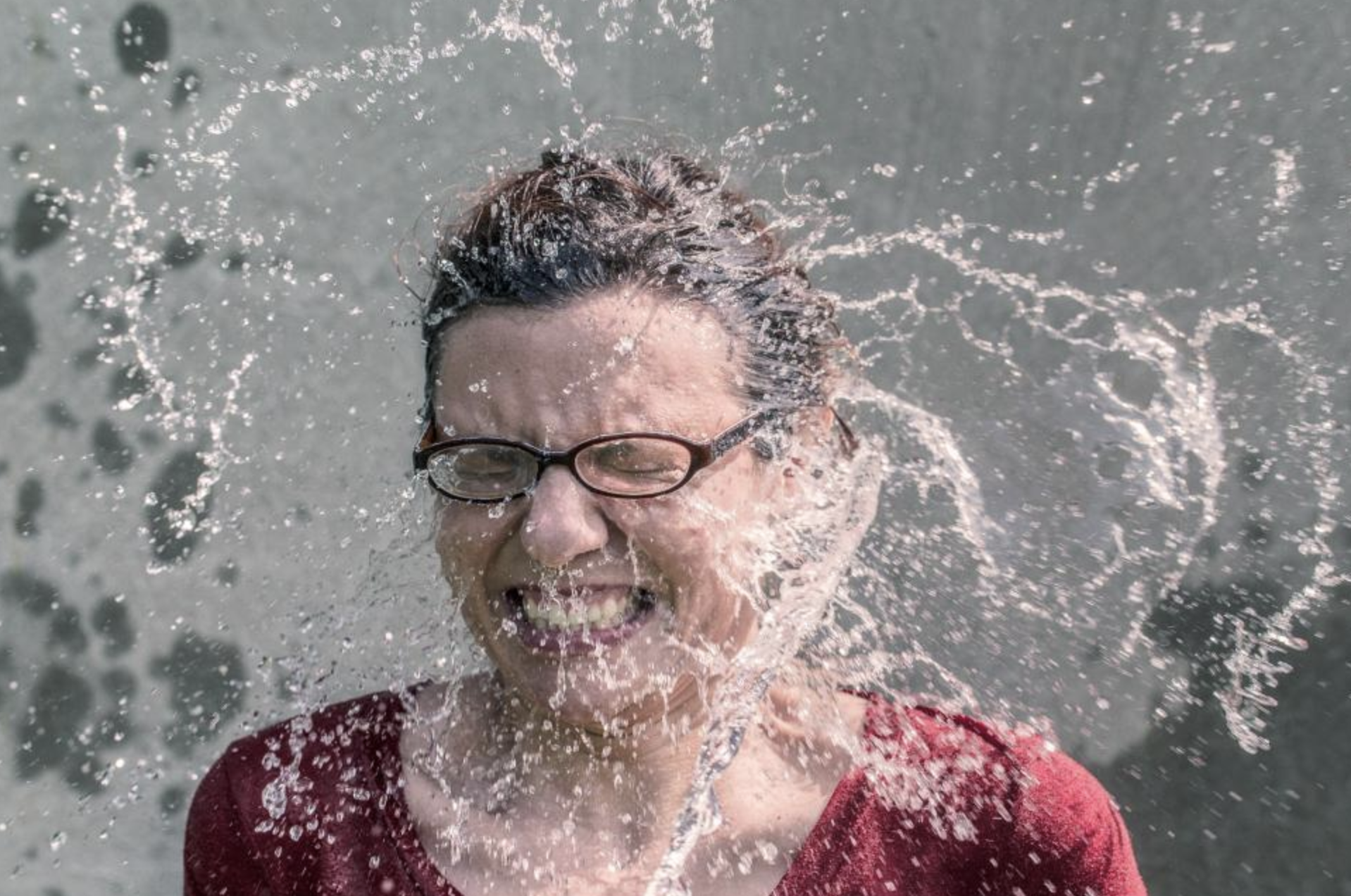
Image Credit: Ryan McGuire
Description: Woman wearing glasses getting splashed in the face with water

Categories
Aesthetics

My Doctor Told Me I’m Broken and Now I Understand Why Charles Schulz is a Genius

Yesterday my doctor told me I was broken, and—shockingly—that’s when I finally understood why Peanuts is funny.


Until that moment, Peanuts had always struck me as the slowest, saddest, most inexplicably beloved snoozefest this country has ever mass-distributed. Now? Oh, I get it. I get why Charlie Brown keeps trudging back to that football. I get why the adults all talk in wah-wah nonsense. I get the whole grayscale, existential doom-as-childhood-charm aesthetic. Because there I was yesterday, sitting on that crinkly paper like a grown-up Peanuts character—hair slightly frizzy, dignity slightly compromised—getting emotionally bludgeoned by someone who pretended he was offering me wisdom.

This life-changing triumph of imagination, this universe-level skill of connecting the dots, has been a long time coming.

Young Me vs. Schulz: The Original Grudge Match

In grade school, I wrote a letter to the editor of our local paper explaining why Peanuts was the worst comic in history and should be summarily banned from the funnies. I laid out the case with great research and even greater authority: the grown-ups clearly had undiagnosed speech disorders; Woodstock was a flying trauma victim; Pigpen was being neglected by every adult in a five-mile radius; Snoopy was flouting leash laws; Lucy was one bad day away from juvie; and then there was Charlie Brown and that endlessly weaponized football. This was NOT a comic. This was a goddamn American tragedy.

I was eight.

My one-kid crusade to purge existential humor from the newspaper fell on deaf ears, and Peanuts endured. (Don’t get Young Me started on Garfield.) And my hatred of the strip endured, too, for decades—until yesterday.

Enter: The Doctor Who Should’ve Been Voiced by a Trombone

My doctor walked into the room, sat down, glanced at my chart like it had personally inconvenienced him and sighed dramatically: “Doctors like me, we hate treating patients like you. You come in with your lists of symptoms and questions. You act ‘chippy’ because of all the other doctors who haven’t listened to you. You all get defensive.”

Yikes. Even Lucy would’ve paused before opening with that.

I looked down at the list in my hand. Oh. Okay. We’re skipping foreplay and going straight to emotional disembowelment. Great. Perfect. Delightful. Why not. Let’s go for the high score today.

“I mean this in the nicest way, but you’re part of the Land of Broken Toys. No offense.”

No offense? NO OFFENSE? If “no offense” were a magical get-out-of-jail-free card, every marriage counselor in America would be out of work.

And this doctor—who allegedly trained somewhere not in the Caymans—just called me defective with the tone you’d use to describe a whimsical Etsy ornament.

Reader, I’d love to say I stood up, planted my feet like Charlie Brown preparing for a righteous kick, and told him off—but I didn’t.

No, I LAUGHED when he told me I was broken. I made jokes. I kept it light. Like he hadn’t just bulldozed my dignity. Because I needed him to help me. And he wouldn’t help me if he was annoyed.

What is a doctor without a patient? On vacation.
 What is a patient without a doctor? Fucked.

“Appeasement Response” or Thanks for the Free Psychiatry, Dr. Snoopy

Then he hit me with this one:
“The way you’re talking right now? All upbeat and to-the-point, that’s called an appeasement response. You do it because of trauma.”

Wow, I’m so glad I have a cardiologist who won’t give me advice on headaches because it’s “not his area,” here to diagnose my speech mannerisms. He didn’t say it for my benefit. He said it to reassert power, to shape the narrative, to keep me compliant, to psychoanalyze me instead of treating me.

Again, I’d love to say I called him out. I’d love to say this was the first time I’ve been in this situation. But I didn’t. And it’s not.

Hello, everyone. My name is Charlie Brown, and this is my football.

The Great Pumpkin of Ableism Rises

“I won’t tell you not to get pregnant. But you feel bad now? How are you going to take care of a baby when it’s born? You can’t put them back in once they’re out, dear.”

Because nothing screams “medical expertise” like infantilizing your patient and disability-shaming.

And let’s be clear: what he said wasn’t “medical advice.” It wasn’t even doctor-adjacent. It was disability shaming with the bedside manner of a printer jam. He didn’t say, “Pregnancy could be physically demanding because of XYZ” or “We’d want to monitor you closely” or even the classic doctor favorite, “Hmm.” No. He skipped right to, “How will you take care of a baby?” as if disabled people have never once raised children in the history of humanity.

And the wild part? He made this sweeping declaration about my alleged inability to parent without even asking the most basic questions. Do I have support? Community? Accommodations? He didn’t care. He immediately filled in the rest of the story with his own eugenics-flavored Mad Libs. In his mind, parenting is done in a vacuum, and my vacuum is apparently haunted. Meanwhile, actual disabled parents all over the world are packing lunches, filling out school forms, and arguing with toddlers about why we don’t eat rocks. But sure, doctor, tell me more about how you have decided I’m unfit.

Lucy Charges Five Cents, This Man Bills My Insurance

Then:
 “The treatment that would help you is a weekly IV… but you know how hard that is to get through insurance? I’m not going to suggest it. Too much paperwork. Do you know how much paperwork us doctors have to fill out? I feel bad for us.”

So he knows what would help me. He’s just choosing not to do it. Because it’s annoying. Cool cool cool cool cool cool.

Imagine a firefighter calmly explaining that the hose would put out your house fire, but the nozzle is kind of hard to twist, so… good luck with the flames, sweetheart.

The truth is, he wasn’t evaluating my health or my capacity to parent or anything rooted in reality. He was protecting his own convenience. And when a doctor decides your existence is too inconvenient, suddenly everything about you gets recast as a flaw: your symptoms, your tone, your questions, your body, your future hypothetical baby. You become a “broken toy” and he becomes the benevolent owner who sadly just can’t fix you. It’s patronizing, it’s lazy, and it’s the medical equivalent of Lucy yanking the football away: predictable, humiliating, and somehow always your fault.

Fragile? No. Just Tired of Adult Voices Going Wah-Wah

He added, “I bet you know people in your family who are fragile like you.” I don’t consider myself fragile. And I don’t know anyone else in my family with this condition—but he didn’t ask.

What about my family history? He didn’t bother with questions. He just said not to worry about it. Or go to the ER if I felt sick.

It was at that moment—truly, spiritually—that I became Charlie Brown. Because even when you try to be polite, to be precise, to be soft enough that no one accuses you of anything… the football still gets pulled back.

Eventually, I put my lists away. Not out of defeat—out of recognition. Recognition that this wasn’t a medical appointment. It was a power ritual. And when I finally snapped, I snapped politely. LIKE A LADY. I texted my friends that he was the biggest asshole alive. (A lie. He’s not even top 20.)

Once you see it, you can’t unsee it. The injustice. The imbalance. The absurdity. The way systems shape you into silence, then punish you for being silent. The way you learn to swallow the scream, to laugh instead of cry, to stay pleasant because your survival depends on it.

And eventually you understand—really understand—why Charlie Brown keeps trying. Because the alternative is giving up entirely, becoming one of the adults who only speaks in muffled nonsense and bureaucratic vagueness. You keep running at the football because the fight to stay human requires at least the attempt at hope.

Good Grief, Healthcare

I walked out of that office, and, suddenly, Peanuts was hilarious. I understand why the strip has endured. The adults don’t understand you. They’re not going to. You get knocked down. You get dismissed. You get analyzed instead of helped. And the whole world expects you to stay grateful, cheerful, nonthreatening.

It’s not a classic because it’s traditionally funny. It’s classic because the tragedy is familiar. And if you can’t laugh at the tragedy, you’ll implode.

Oh, that Charlie Brown… when will he learn? Probably the same day my doctor does.

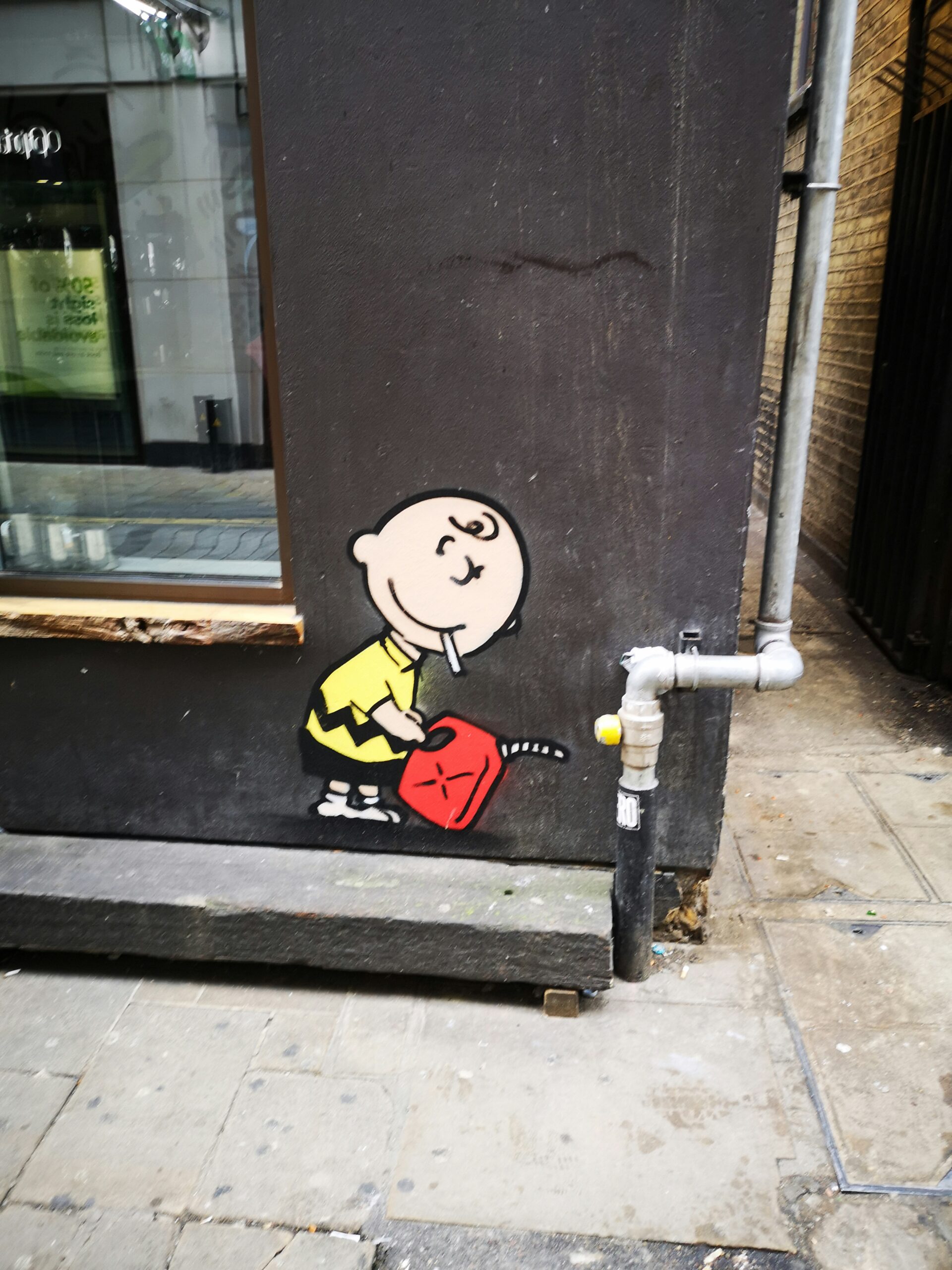
Image Credit: Pankaj Shah
Description: Image of graffiti. Charlie brown has a cigarette in his mouth and is holding a can of gasoline.

Categories
Aesthetics

Jalynn Norling Autumn Therapy Review

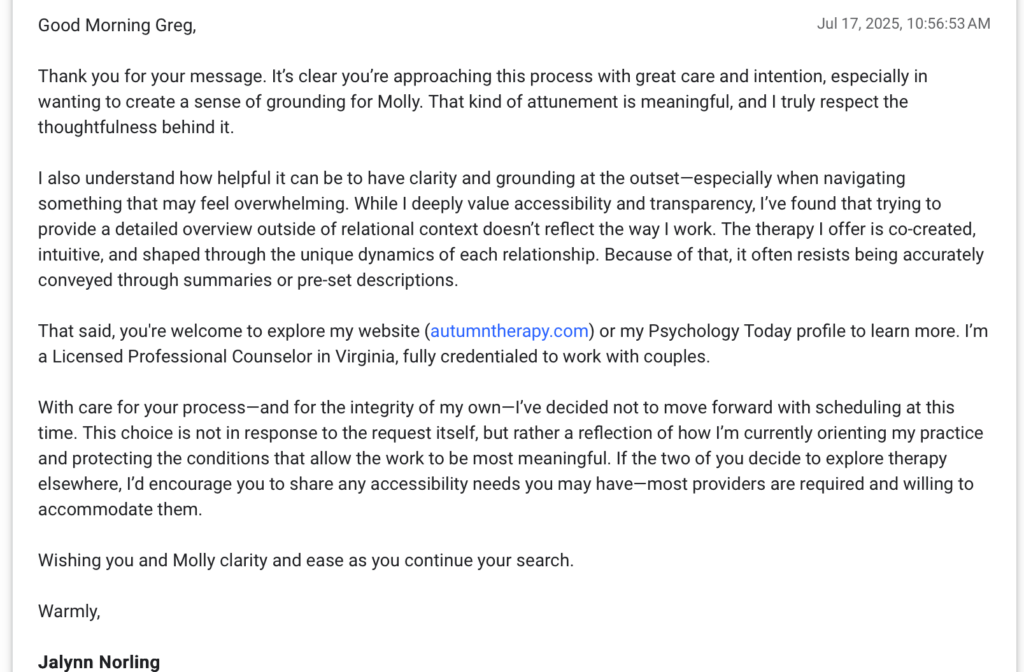
Finding a therapist is so hard, y’all. We reached out to Jalynn Norling, who I’m sure is a well-meaning person, but unfortunately, she wasn’t accommodating. Her website specifically says she works with neurodivergent folks, but that didn’t match our experience.

My husband and I have a short list of questions we send to potential therapists to help us figure out if they’re a good fit—because like many people, we don’t have the time or resources to schedule consultations or pay for sessions only to discover it’s not a match. The questions are very standard—things like “How often do you work with neurodivergent clients?” and “What’s your therapeutic style?”

After a back-and-forth, Jalynn declined to answer our questions or continue the conversation. She responded with some vague, buzzword-heavy language and referenced that most providers are required to offer accommodations—but didn’t actually model that in her own approach. Unfortunately, this kind of response is all too familiar. As a neurodivergent person, I often hear the word accommodations used in theory, but when it comes to putting that into practice, people back away. It’s disappointing and honestly hurtful—especially when it comes from professionals who position themselves as neurodiversity-affirming.

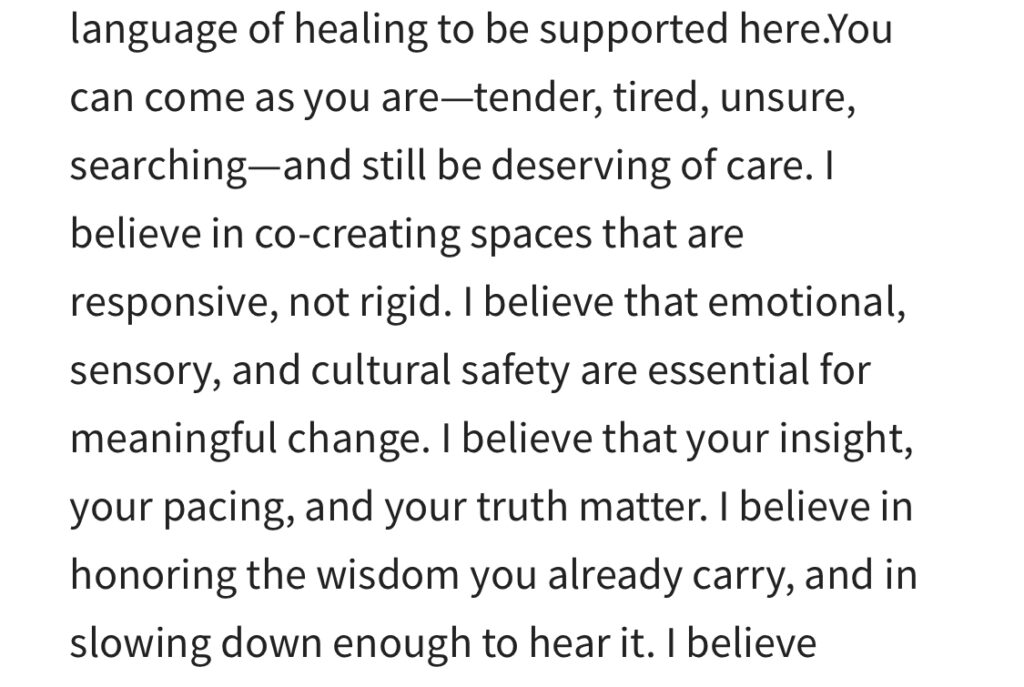
And it felt really out of step with what her website says:

I am tired, unsure and searching—and I was hopeful this could be a good fit. But a truly responsive space includes being willing to answer questions up front. Feeling emotionally safe, especially as a neurodivergent person, often starts with clear communication and flexibility. I didn’t get that here.

I’m sharing this because the process of finding a therapist is already so exhausting. If I can save someone else from the stress, it’s worth the time it took me to write this up.

Image Credit: Leuchtterm Entertainment

Categories
Aesthetics

Courtney Parks, Water Lily Therapy Review

I have an embarrassing phobia.

Yup, it’s true. I’m not afraid of normal stuff like snakes or spiders or heights. I’m afraid of something I’ll nickname “yellow hats.” (I’m not going to name the actual phobia here because that just feels like asking to get roasted on the internet.)

I also have OCD.

A few months ago, I decided it was time to take real action. I was already seeing a therapist, but she wasn’t particularly knowledgeable about OCD or phobias. So I started the emotionally exhausting, time-consuming process of finding a new therapist.

I wrote up an email to explain myself to potential providers—my quirks, my challenges, my strengths, my OCD, and yes, my fear of “yellow hats.”

And it worked. After just one interview, I met Courtney Parks at Waterlily Therapy LLC, and I felt an immediate sense of warmth and connection. She seemed friendly and open. I was actually excited to begin therapy.

At the same time, I was nervous. I’ve been abandoned a lot in my life, and I worried I’d get attached only to have that stability pulled away. I even voiced that fear in session, and Courtney said she understood. That helped me trust her.

So I started to feel something like therapeutic love—not “love” love, but a kind of hope and gratitude. The kind of bond that makes you think, “Maybe I can finally get help.” I wish we had better language for that kind of connection.

After a few sessions, I realized that although I had talked about my “yellow hat” issue in detail, I hadn’t asked about it in direct relation to her. So I sent an email asking, somewhat awkwardly, if she planned to, um, buy a yellow hat.

She wrote back that she was considering it.

The stomach drop I felt was intense. If you’ve ever had a phobia, you probably know the feeling—your brain tells you the threat is irrational, but your body doesn’t listen. If you haven’t experienced it, this link gives a good overview.

I didn’t want to walk away from therapy with her. We had built rapport, and I genuinely liked her. Plus, I was SO overwhelmed—my mom had cancer, and the same week, my 2-year-old service dog (and best friend) was diagnosed with aggressive cancer. Emotionally, I was hanging by a thread. I knew I wasn’t in a place to go searching for someone new.

So I replied to her email, explaining that I was upset, but I just needed a little time and space. I told her that I planned to circle back after my pup had her first cancer surgery.

She responded by terminating me as a client. She said not to take it as a rejection, that she was making the decision out of ethics and kindness.

And maybe she truly felt that was the right, ethical thing to do. But from where I stood, it felt like being dropped when I was already drowning.

I know that to someone in a healthy place, this might not seem like a big deal. Maybe I would’ve ended things myself down the line. But the hardest part for me was that I didn’t get to decide. I didn’t get a conversation, or a warning—it was just over.

As someone who’s neurodivergent, I’ve often experienced people stepping in and making decisions for me—without asking how I feel or what I need. It’s a painful pattern I’ve lived through many times, and in that moment, it felt like it was happening again in therapy, where I had least expected it.

From the start, I had asked Courtney—what if I said the wrong thing, or expressed frustration? Would she leave? And she had assured me she wouldn’t. So when she did, it hit hard. I wasn’t just sad; I was disappointed in myself for believing it would be different.

And when she told me not to take it as a rejection, that it was just “ethics and kindness,” it didn’t land that way for me. Maybe that was her intent. But it still felt like a rejection. The difference is—she got to move forward and find another client. I had to sit in the waiting room of the vet’s office, waiting to hear if my dog’s cancer surgery had gone okay, and process that I’d just been let go by my therapist, too.

Now I get to start the therapist search all over again.

That’s my experience. Hopefully it won’t be yours.

I’m sharing this not to blame or accuse, but because I wish I had known what to look out for. I wish I’d seen the warning signs earlier. This is just one story—mine. Others may have had very different experiences, and that’s valid, too.

Photo Credit: Nik Shuliahin

Categories
Aesthetics

Review of RTZ Hope Retreat

Grief is a tricky thing, especially the grief of losing a child. When my loss was nearing its one-year anniversary, and I was still heartbroken, still processing the grief, I knew I needed more help than a weekly therapy session. So I looked into grief retreats.

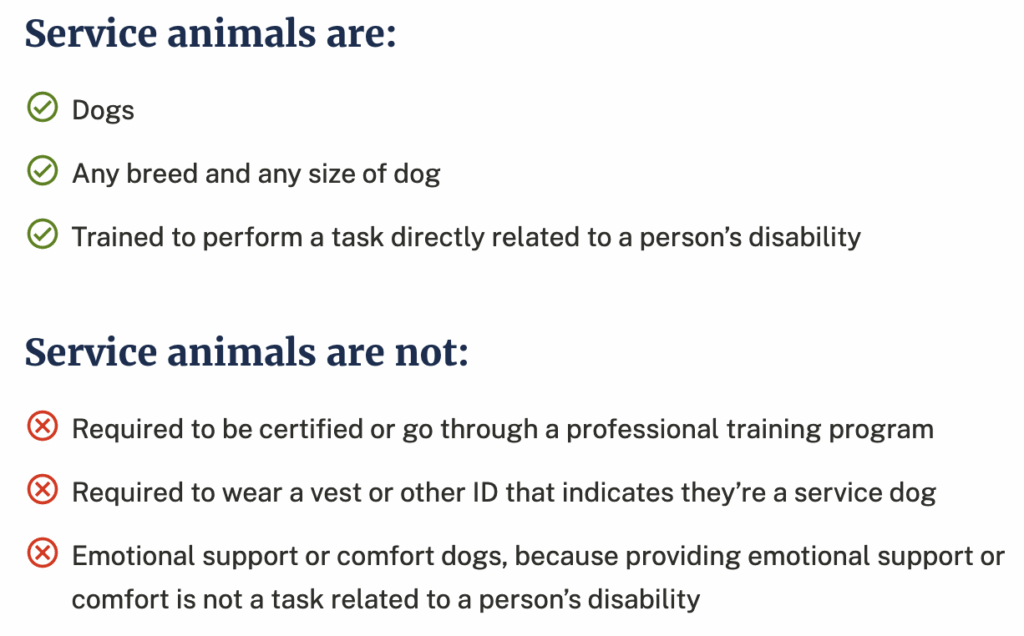
I wanted to attend the RTZ Hope Retreat, but I didn’t feel comfortable going because of their lack of understanding regarding service dogs. As someone with a disability, I’m not required to message venues about bringing a service dog. But I always like to give people a head’s up. Ninety-nine percent of the time it’s fine, but if there’s a 1% chance that someone won’t welcome my dog, I don’t want to be there.

To their credit, employees wrote to me and told me that having my dog would be OK. But then they wrote to me saying, “service animals do have certification, which emotional support animals do not.” The retreat told me that I would not be able to book specific sleeping accommodations because of my dog.

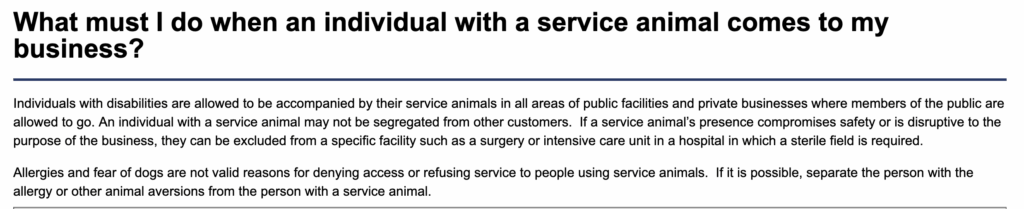
I explained, “Most people don’t know this, but you’re not required to have a certification to have a service dog. And you’re also not allowed to be segregated to specific areas because of the animal.”

And, “(The information) is available on the federal government’s website and on CA’s info page. Hopefully, once they read the laws they’ll be a bit more welcoming. =)”

Unfortunately, the employees I corresponded with did not admit to their error. I felt like if they didn’t understand the basic laws surrounding service dogs and weren’t willing to look into it then there would be other problems if I went on the retreat. And I didn’t think I could handle trying to deal with those problems while also trying to process my grief.

I wanted to post this review so hopefully the next person with a disability won’t have the same issue I did.

Here is a link to the federal rules regarding service animals:

Here’s another link regarding the federal rules:

Photo Feature Credit: Priscilla Du Preez

Categories
Aesthetics

Future, Meet Past

I found an old hard drive and inside was a treasure trove of poems I wrote in 2008 (or, at least I last opened the doc in ‘08, eep)! This is back when I still used double spaces after every sentence and had an AOL account. Crazy how time flies. So here’s what little me thought poetry was all about.

Click the link below to read more

Categories
Aesthetics

Unfortunate Branding #3

Sweat

Japan

Categories
Aesthetics

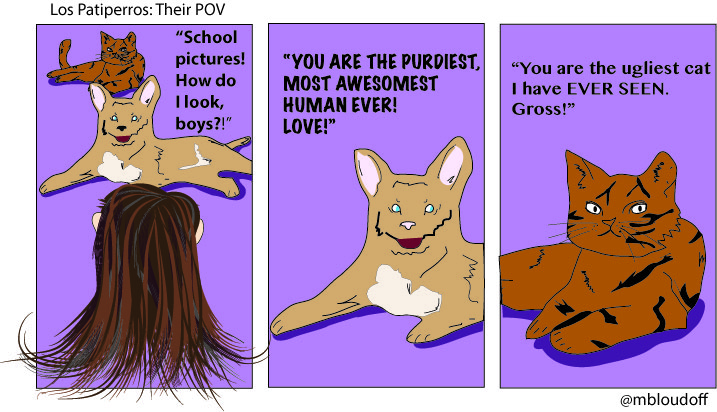
Their POV

pictureday

Categories
Aesthetics

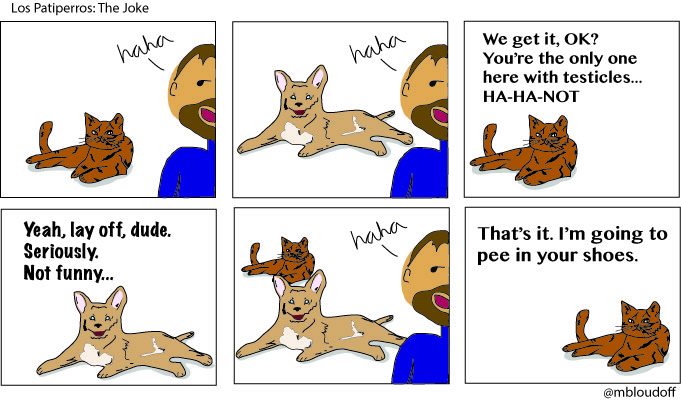
The Joke

catcomic

Categories
Aesthetics

Lady Problems #2: Every Damn Time

ShavingComic_v2