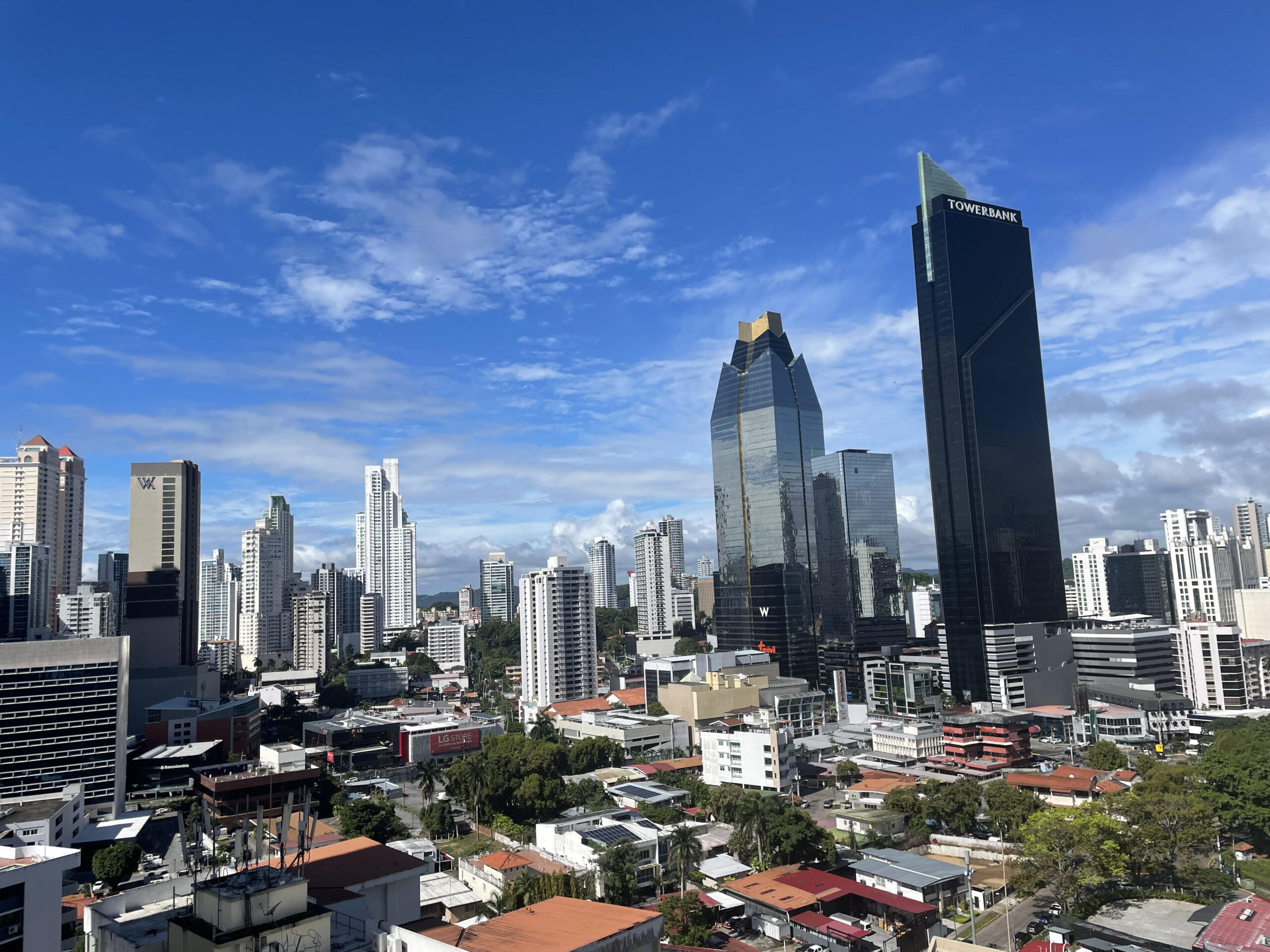
Picture of the Panama City skyscrapers and a big blue sky.

Things to do in Panamá City, Panamá

How to get there

When you buy your tickets, note that the seats on Latin American airlines are smaller than those in North American/Europe. The “Extra Leg Room” seats are about the same as a standard US economy seat, and the “Economy Seats” are meant for exceptionally tiny people. Plan accordingly!

Panamanians use US dollars, so we were able to tip liberally throughout the trip. Bring lots of small bills!

Can you drink the water in Panamá?

Yeah, you can. But if you’re a gringo, I would recommend sticking with bottled or boiled water. If you’re at a resort, you’re probably fine drinking things with ice, but anywhere else I’d skip it—you don’t know where the water for the ice came from. It’s just not worth getting sick over something that simple.
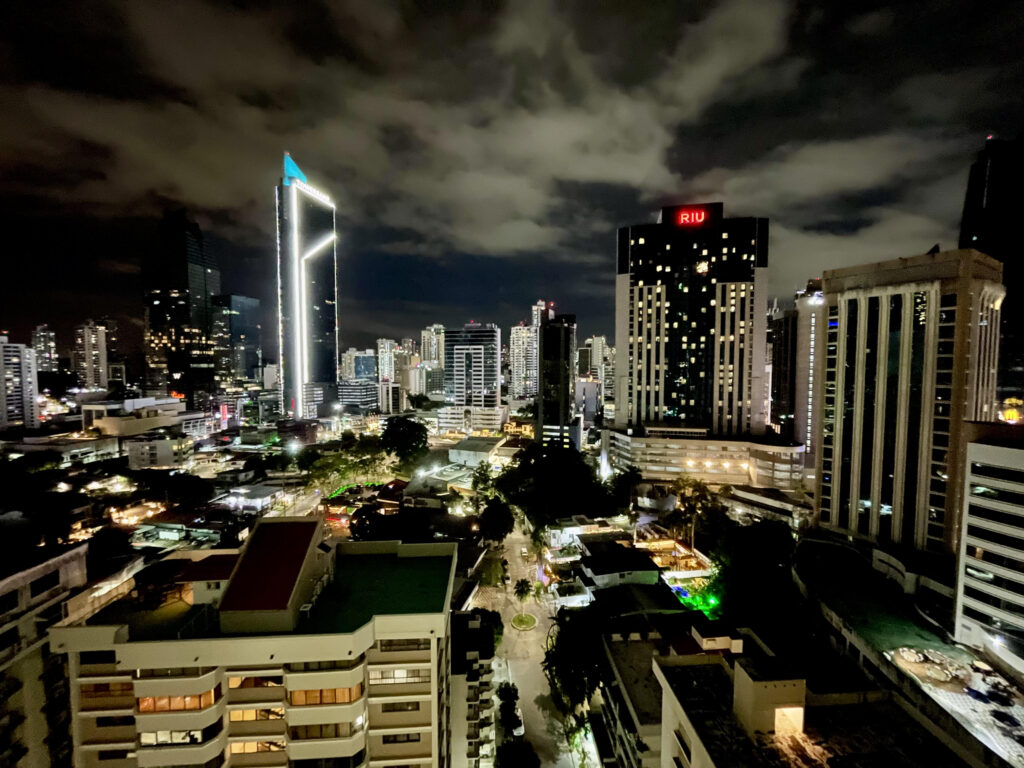
Skyscrapers of Panama City at night. Background is a dark navy sky with wisps of white clouds.

Where to stay in Panamá City, Panamá

When you’re searching for places to stay or things to do, make sure you’re not accidentally looking at results for Panama City, Florida.

We stayed in a condo in the business district. Oddly, there was a Thursday rooftop party with bongo drums, but thankfully it ended before midnight. Latin American cities aren’t usually quiet at night, so that actually felt like a win.

In the morning there was a lot of honking as people finished their commute, but it wasn’t too bad. I’d still recommend staying in the business district.

The phrase of the day was “ta bien,” or “all good,” which perfectly captured the mood.
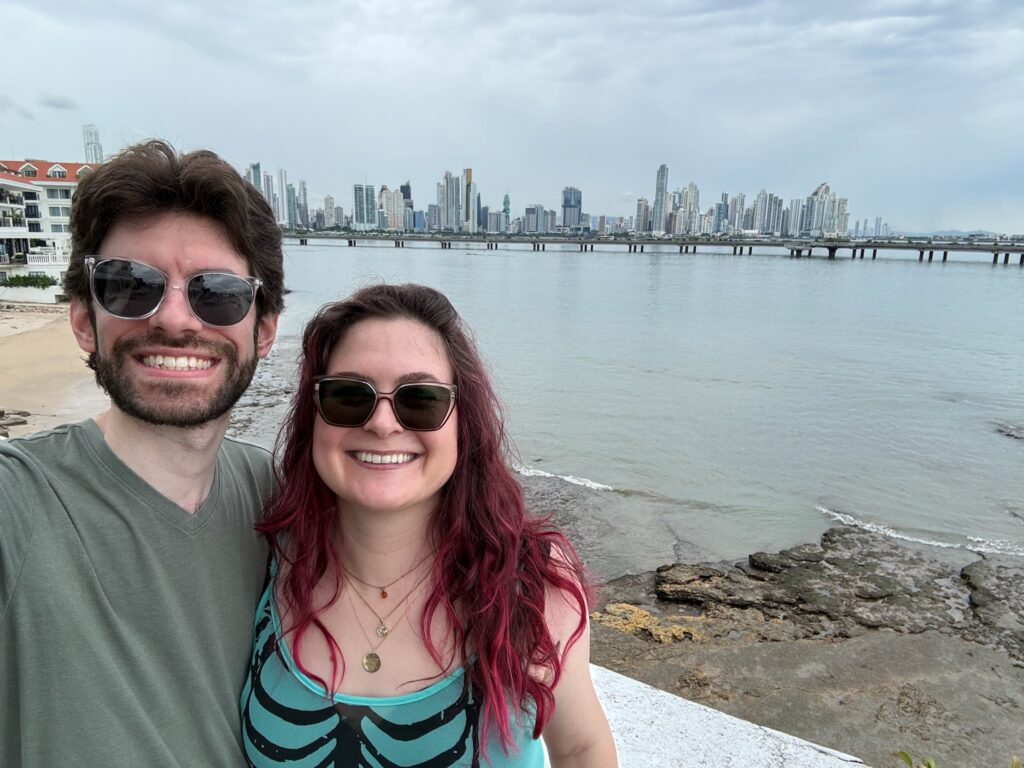
Man and woman with the city skyline in the background.

Things to do in Panamá City, Panamá

Getting around via Uber is cheap and super easy.

I highly recommend making the MOLA Museum in the Old Quarter your first stop. It’s a free museum (you can leave a tip at the end!), and the stories behind this Indigenous art form are genuinely fascinating. You can get through it in 30 minutes if you’re quick or about an hour if you’re relaxed.

Climb the stairs around the Plaza de Francia and see the molas created by the women of San Blas. If you ask about the stories, they’ll happily tell you. It helps to have someone in your group who speaks Spanish. Even basic Spanish is fine—the accent is very clear and people speak slowly.

We bought three molas for $50. It takes dozens of hours to make a mola, so we didn’t bother haggling. These women deserve to be paid for their art.
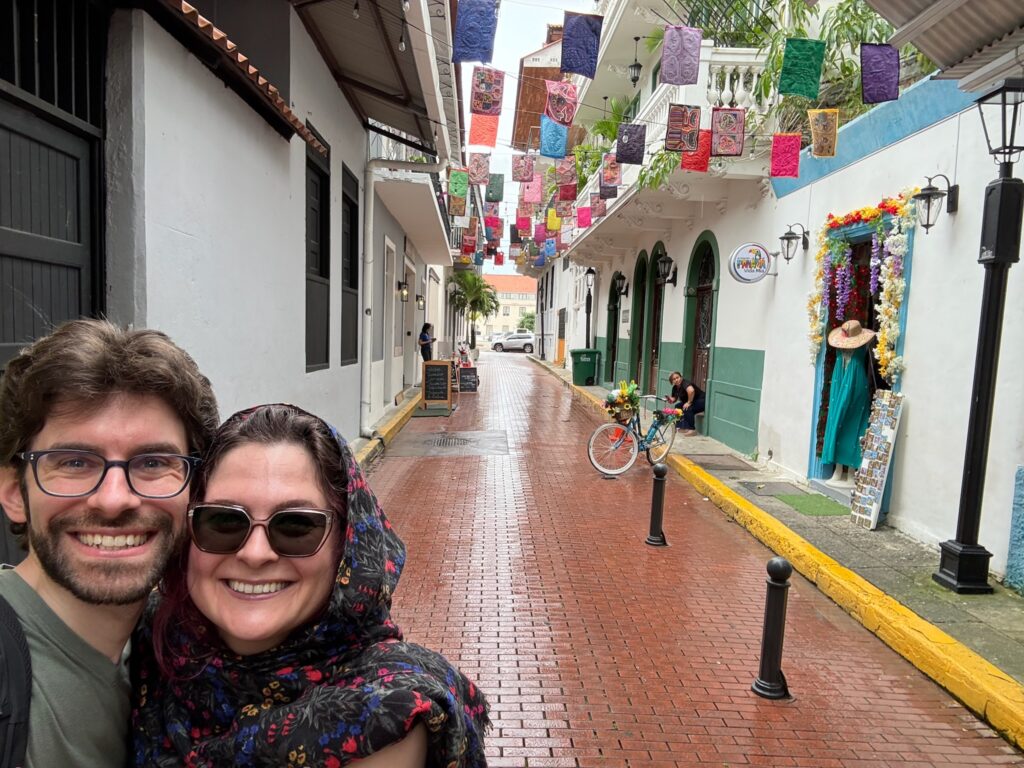
Man and woman on a street decorated with colorful molas.

A lot of vendors also sell sea shells. Try not to buy those; it’s not sustainable and it’s bad for the environment.

I’d also recommend stopping by the Artesenias Panamá Vida Mía art studio, which is a short walk from the molas. Great photo ops and we ended up buying some art there, too.

Panama boasts the “most expensive coffee in the world,” but you can try it for cheap in the capital. There are shops offering tasting experiences for much more if you’re a coffee aficionado. I’m more of a regular coffee person, so the $8 cup of geisha at Unido Coffee was perfect for me. We also tried rosemary lemonade coffee, which was surprisingly really good.
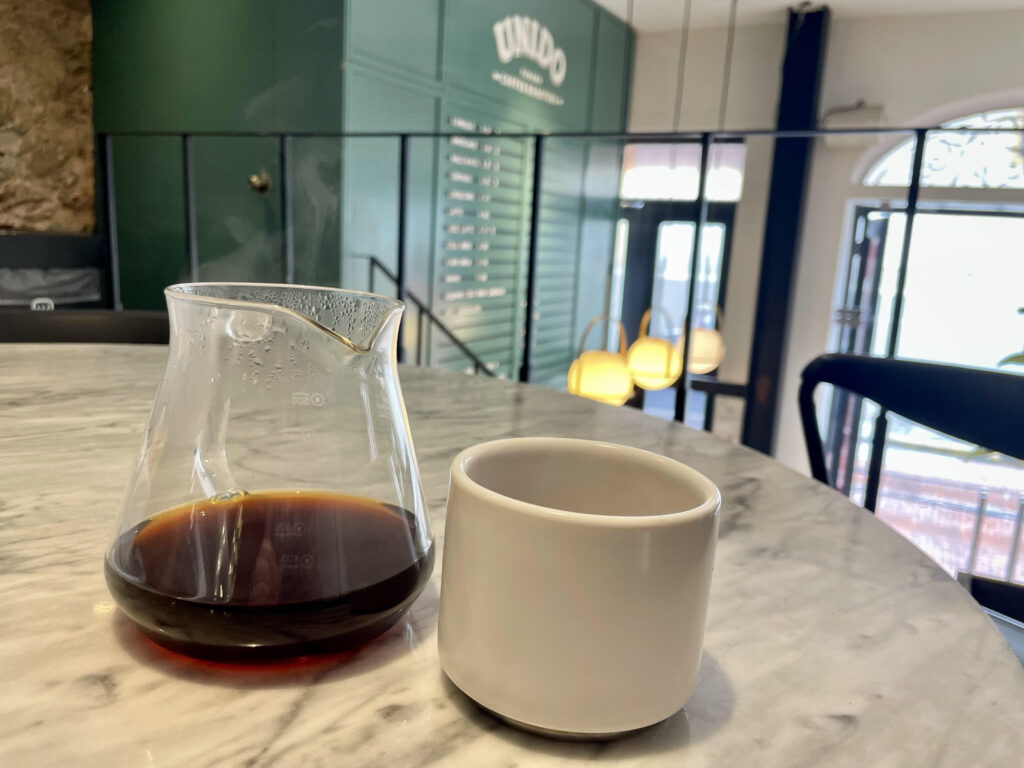
Photo of a cafe. In the foreground, there's a glass carafe of coffee with steam coming out of it and a white mug. In the background you can see the UNIDO coffee sign.

If you have food allergies, it’s easier to order through Uber Eats than to go out. Many restaurants have pre-made dishes and won’t be able to make changes, the service is incredibly slow, and sometimes staff don’t know what ingredients are in the food.

If you don’t have food allergies, ta bien! Just relax and don’t plan on getting anywhere quickly—you’re on Latin American time.

Greg went to the MAC Panamá Museum and MAC Panamá Museum Satellite. He only needed one ticket to tour both venues!

After some research, we decided not to go to the Panama Canal Museum. Instead, we stopped at a lookout point, watched the boats inch their way across, took some pictures, and continued on.

If you need groceries, get them in the capital. There are stores in other towns, but nowhere near as many options. And outside the capital, you won’t find souvenirs or basic US-type items—flip flops, towels, etc.—so stock up early and supplement as needed.
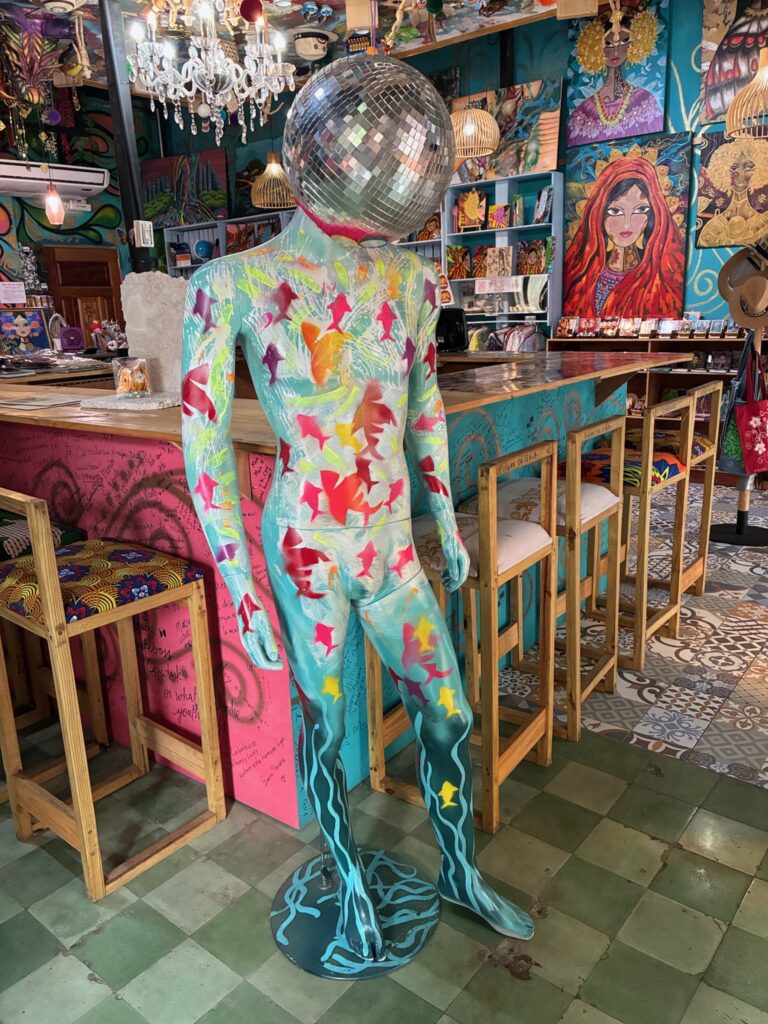
Photo of the Artesenias Panamà Vida Mía art studio. A mannequin painted blue with fish on it and a disco ball for a head, stands in the foreground.

Driving in Panamá

Driving here was easier than in any other Latin American country we’ve visited. The roads were well maintained, and although drivers make their own rules, there’s a method to the madness. If you’re a confident driver, you’ll be fine.

Once you get into smaller towns, paved roads can suddenly turn into pocked dirt roads, so I highly recommend getting a car with four-wheel drive just in case.

If you’re trying to make a flight, leave twice as much time as you think you need. We got stuck in an hour-long traffic jam in one of the small towns on our way back to the airport!
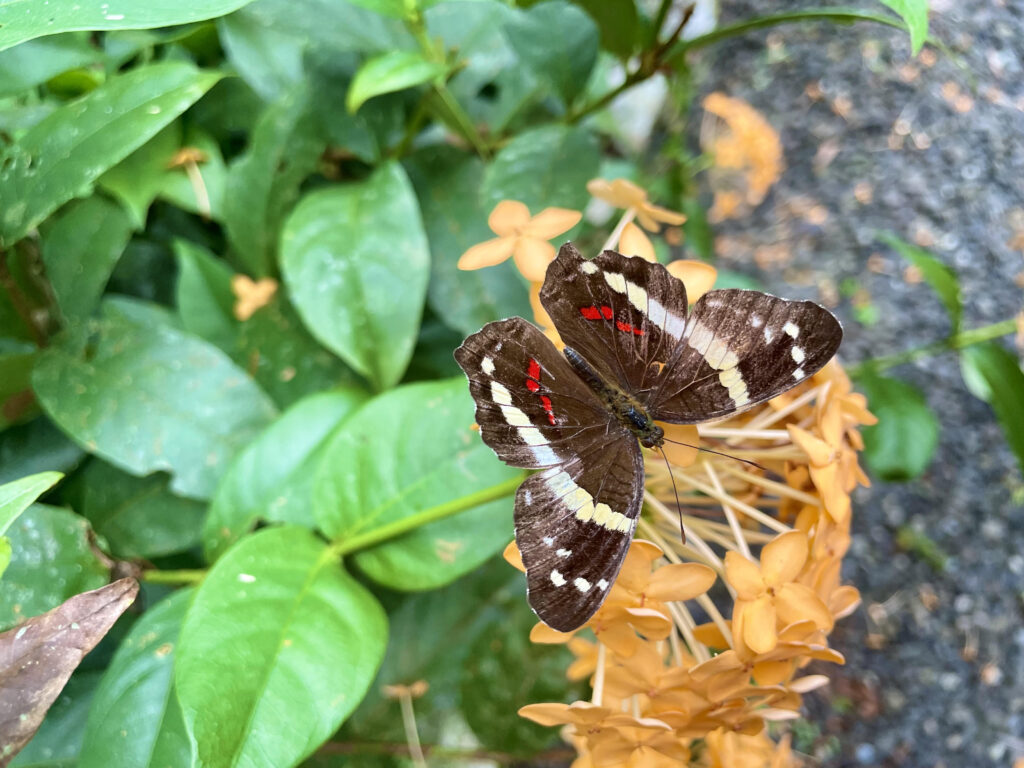
Heliconius sara butterfly with brown wings, white stripes and red dots. Background is green leaves and yellow flowers.

Outside Panamá City

We stopped at the Gamboa Rainforest Reserve for a basic lunch. Think white-people food—chicken fingers, tiny burger sliders. I brought instant noodles, and they were happy to give me boiling water.

We bought tickets for a wildlife tour because we really wanted to see the poison dart frogs. They had us buy tickets right before the tour started, since sudden weather changes can cancel it.

We saw a capuchin monkey, butterflies, hummingbirds, dart frogs, sloths, Panama’s national flower and even a one-day orchid. Lots of magical little moments. The guide was knowledgeable and gave us plenty of time to explore. Very hands-off unless we wanted more info.
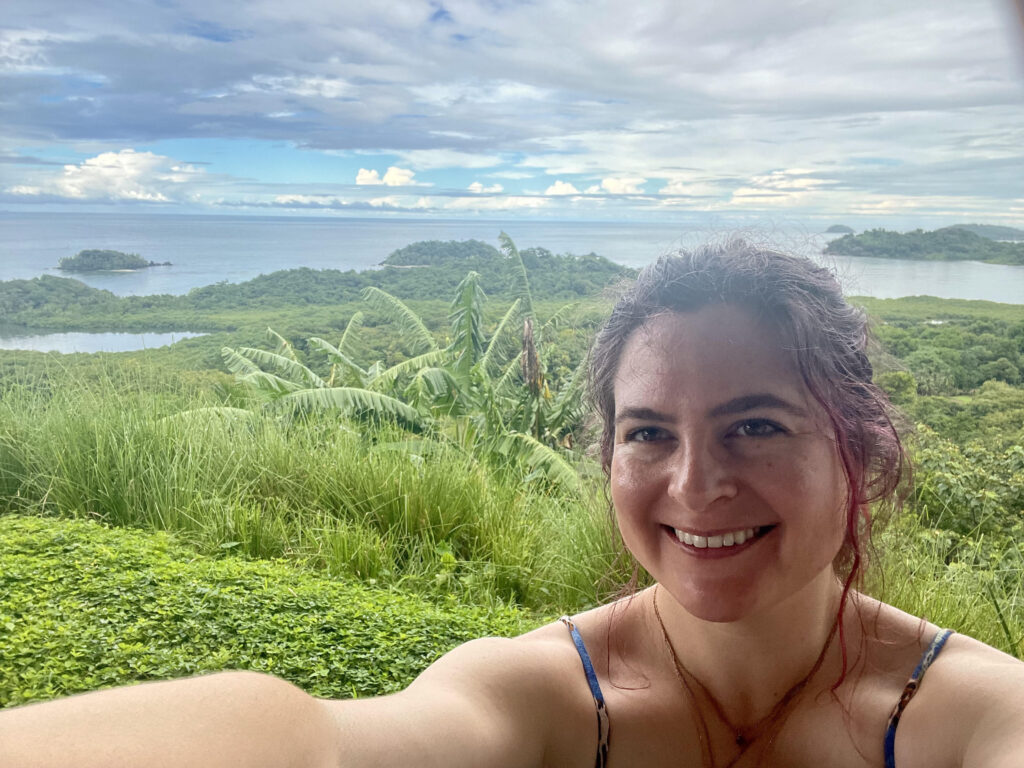
Selfie of woman with wavy, red hair. In the near background is green jungle. In the distant background is the ocean. Islands are visible. The sky is blue and full of white clouds.

Visiting Distrito de Portobelo, Panamá

This day was a whole collection of creature sightings: a pelican, falcon, hummingbirds, capuchin monkeys, wild calla lilies, cows, oxen, vultures, a toucan, and a random cat-dog-chicken-duck assortment that felt like the beginning of a folktale. All the dogs were male for some reason. (Can someone explain this to me??)

The howler monkeys sounded a lot like California sea lions, which was disorienting but hilarious. (And then less hilarious when they woke us up at 5 a.m.) We wondered what a group of howler monkeys is called and decided the only correct answer is “a menace.”

No beach worth visiting.
Power cut out a few times but not for long.
Make sure you rent a place with AC.
You don’t need hot water, but it is nice. Many places come without.

You’ll definitely need an eye mask and earplugs. When it rains, the roof becomes a drumline—SO loud. A lot of places don’t have curtains or blinds. I’d also recommend bringing bird-window stickers because birds flew into our windows more than once, and it was startling for everyone involved. *sadfaces

Make sure to bring ziplock bags and keep everything (even toothpaste!) inside one. The ants are determined in the rainforest!!
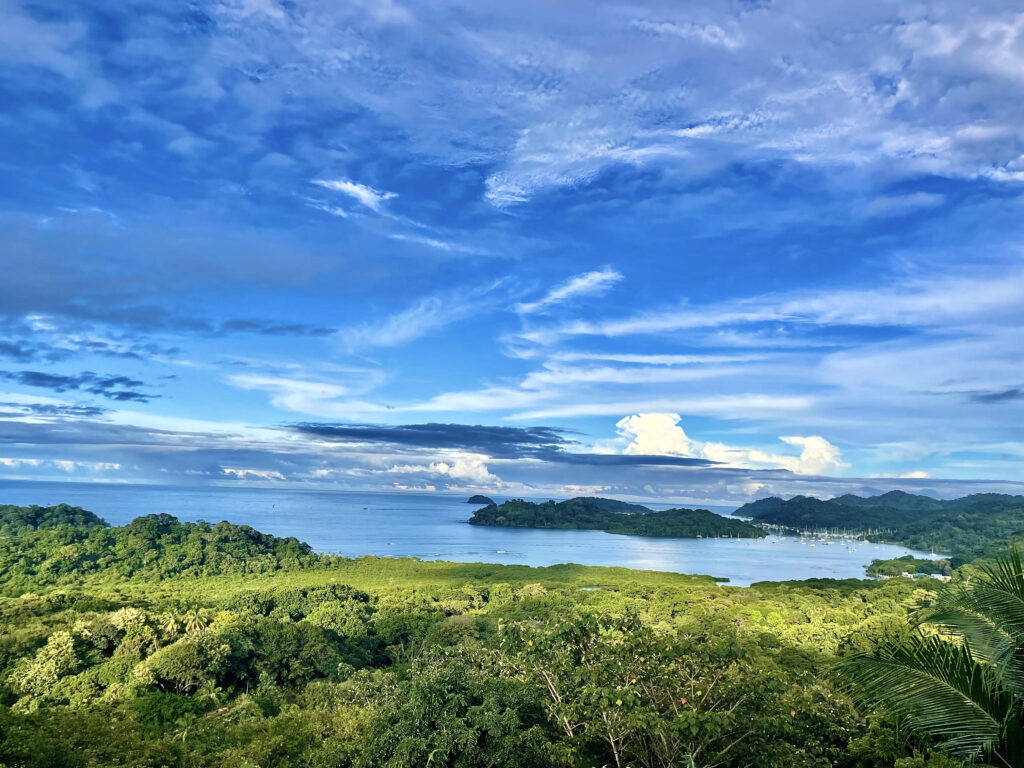
Photo of a landscape. The near foreground is green rainforest trees. The middle is a blue-water bay ringed by mainland and a small island. In the distance, the water continues indefinitely, met my blue sky and storm clouds.

Overall, it was an amazing trip, and I highly recommend visiting. The city and surrounding areas have something for everyone: the hardcore hikers, photographers, art enthusiasts, foodies, families and folks who just want to meander and sit down for a nice meal and a good café.

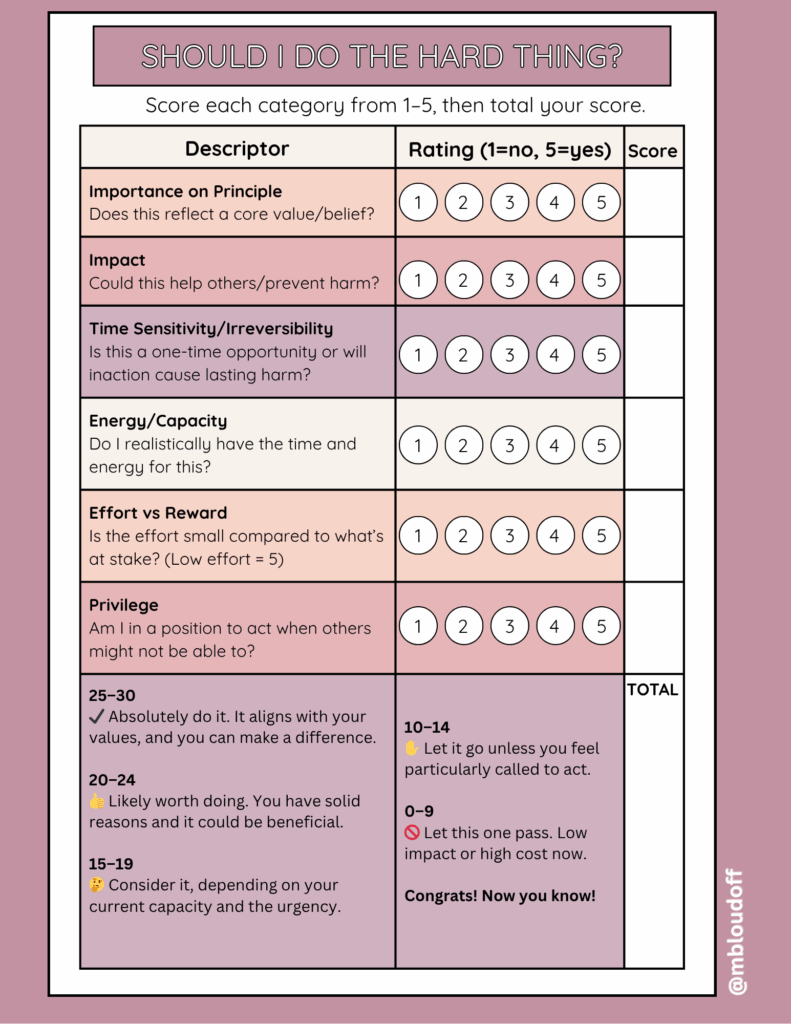
Should I Do the Hard Thing Rubric

I’m someone who’s very justice-oriented. If I see something wrong happening, I have a hard time just letting it go. Sometimes, that’s a great quality. Other times, it’s absolutely exhausting.

I constantly run into little moral quandaries. Like, when my husband and I were on vacation, we found a lost dog—an older pup, clearly confused, dehydrated, and wandering into traffic. No one stopped. Even though we were just visiting, we spent hours trying to find his owner. When animal control ghosted us, we paid for an Uber to take him to the nearest shelter. Worth it? Absolutely.

But not everything is so clear-cut. Like recently, my doctor’s office overcharged me $30 for a procedure. Do I hate that? YES. Do I think they probably do it to other people too? Also yes. Is it wrong? No question. But… should I spend 3+ hours fighting a $30 charge?

Cue the “Should I Do the Hard Thing?” Rubric!

Even though my entire being wants to go to battle, the numbers don’t lie: it’s probably not worth the soul-crushing hold music and circular phone conversations that would eat up my whole afternoon.

What do you think? Agree? Disagree? How do you decide when it’s worth taking on a fight like that? LMK!

Image Credit: Glen Carrie

Best Free, Bodyweight Workouts on YouTube

I hate working out. It’s SO. DAMN. BORING. and fraught with social interactions I’d rather avoid.

I tried running. I really did. I got the phone apps. I got fitted for the shoes. I joined training programs. It was multiple-exclamation-points-terrible.

Running around outside makes me feel like an idiot. I’m dripping sweat in a ratty T-shirt and shorts that are probably too short as I pass office workers heading into the city with makeup and expensive suits. Or, running at night, I end up as fodder for the scourge of mosquitos that follow me around in a cloud as soon as I step outside.

Jogging on the treadmill at our apartment’s gym is almost as bad. Thank god for climate control and the absence of insects, but dear lord, it’s just so monotonous, and there’s only so much a workout music playlist can do before it becomes completely useless.

So that leaves an actual brick-and-mortar gym. And, for a long while, I was a gym rat. I went every day for at least an hour. But, the problem with going to a gym that frequently is that you start to make friends.

Click the link below to continue reading:

Read More

Poking Things in Australia

Growing up, my mother constantly had to tell me not to touch things.

Don’t touch the cookie jar (too high), don’t touch the remote (too loud), don’t touch that counter (too unsanitary), don’t touch the stove (too hot), and don’t touch that mud puddle (oops, too late). In fact, I think it might’ve been easier for her to outline the things in life I was able to touch, as opposed to keeping up with my desire to stick my hands in places they didn’t belong.

Fast forward a decade or two, and I’m well into adulthood. Years of social conditioning have taught me that touching random stuff is generally frowned upon—I do it anyway.

I love poking things: buttons, soft leaves, the pristine surface of a newly opened jar of peanut butter. But my true addiction is poking animals. Fortunately for me, this isn’t usually an issue. In DC, the only animals close enough for me to poke on a daily basis are rats and pigeons (aka rats with wings). Ain’t nobody got time for that mess.

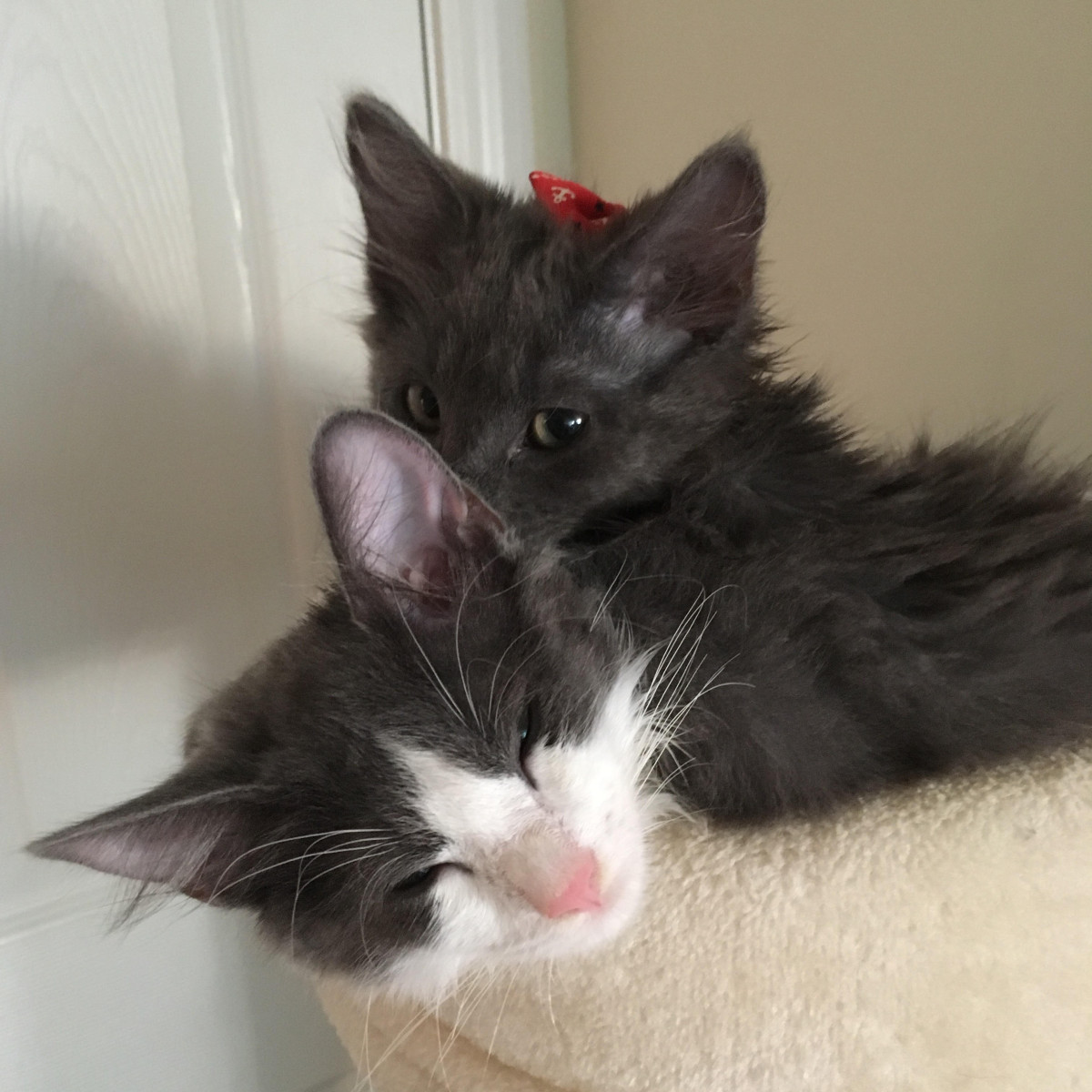
Then there’s the non-issue of pets. I’ve had pets my entire life: dogs, cats, birds, a chicken (once), and all of them were mostly OK with/didn’t hate a gentle tummy poke. (Hey, I said I’ve had pets my whole life, not that I was a particularly good or savvy pet owner.) The animals I live with right now, which include two cats and a tall, hairy man, are trained really well/trapped in a long-term Stockholm Syndrome-type situation. Both ways, it works for me.

Yup, things were going pretty well on the poking front, but then the Significant Other took me to Australia, the land of extremely poisonous, vicious, murderous and pokeable animals.

*We were there for two weeks. Now’s the time to place your bet. Exactly how many of my fingers ended up in some exotic animal’s digestive tract?

Click the link below to continue reading:

Read More

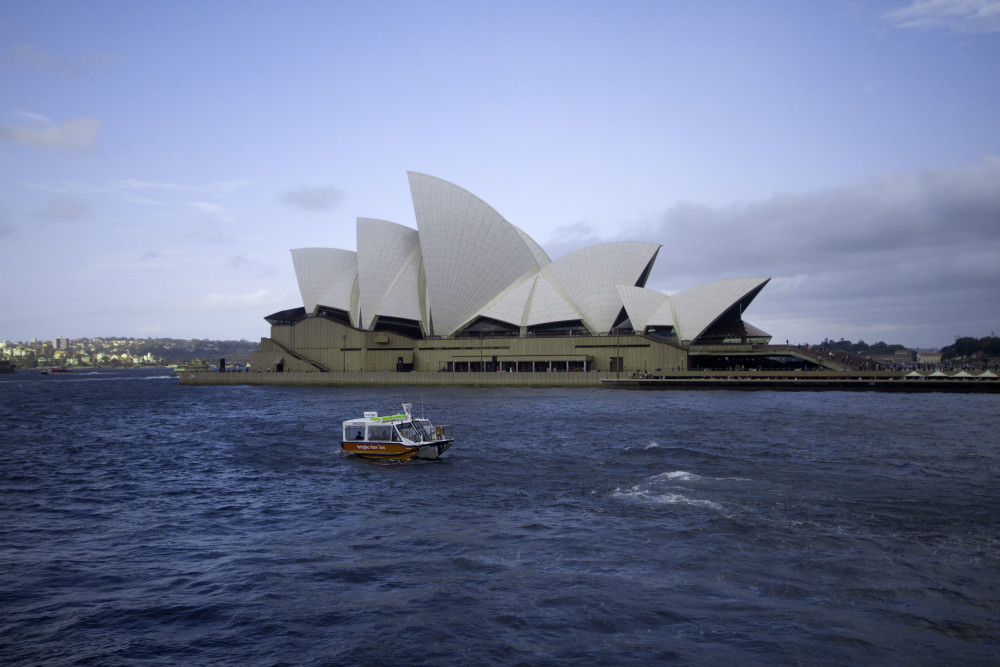
Sydney Opera House

Top Things to do in Sydney

One of my life goals has been to visit all seven continents—before I turned 30. WELP, it took some convincing, a LOT of planning and, not one, but TWO hellish plane rides, but I made it happen! The Significant Other and I spent four days in Sydney. You can definitely do it in two, but we wanted to go slow, take it all in and spend some time recovering from jet lag before we continued on our journey. Here are our recommendations. Enjoy your time Down Under!

  • Watch the sunset “over the Sydney skyline. Ah, that famous Sydney skyline. There is nothing quite like watching the sunset over the harbour bridge. Head over to Darling Point for the best views over the city during golden hour.”
    • You can also hike to the top of the bridge! We didn’t opt for hiking because it’s pretty expensive, and we wanted to save up for a diving trip at our next stop. But, if you do it, let us know how dizzyingly terrifying it was in the comments!
  • Take the Ferry to Manly: “No trip to Sydney would be complete without taking the ferry over to the beach town of Manly. A return ticket costs around $13.20 and the ferry departs from Sydney Harbour, taking around 30 minutes each way.” 
    • Manly is a really cute little beach town. We went when it was windy and rainy so the only people on the beach were surfers. It was still a LOT of fun to take the ferry—sit on the upper deck at the front of the boat, and prepare to be splashed by the waves! Plus, we got some great photos of the Sydney Opera House. Walking around Manly was relaxing in the drizzle. I’m sure it’s a packed tourist trap in sunny weather! If you do make it over there, check out their aboriginal art store. It’s right on the main path from the ferry to the beach, on the right-hand side. You can’t miss it!
  • Art After Hours (Wednesdays) 
    • Rub elbows with the locals and enjoy cool art! We were way too jet lagged to do this when we first got in, but we’ll definitely attend on a future trip.
  • Free walking tour
    • 2.5-3 hrs
    • 10:30am and 2:30pm Every Day from Town Hall Square.
    • “No need to book. You’ll find your guide wearing a bright green ‘I’m Free’ T-shirt on George St between Sydney Town Hall and St Andrew’s Cathedral.”
    • If you’re well-traveled, this might be a bit of a bore. Everything in Sydney is so new that there’s not too much in the way of history. I’m glad we took the tour because I enjoyed learning about the culture and history that does exist, but I could’ve skipped it if we’d been crunched for time.
  • The Hayden Orpheum: Cinema in operation since 1935
    • It’s a trek to get out to the theater, but I’m glad we did it. We got to see neighborhoods we wouldn’t have otherwise explored. Plus, the theater really is a lot of fun to check out, and you can’t beat an action movie on a rainy afternoon!
  • Paddy’s Markets
    • This is where you go to get all your souvenirs. The prices are over-the-top for clothing so head to a thrift store instead. Paddy’s Markets is really all about the boomerangs (made in Indonesia) and cute koala keychains. It’s a tourist trap, but it’s been in operation forever and, well, you are a tourist, aren’t you?
  • Sydney observatory
  • Museum of human disease
  • Wendy’s secret garden
  • Lawn bowling
  • Ground of Alexandria

    Day Trips

Best Free iPhone Games for Calming Anxiety and Relaxing

Stress and anxiety suck, big time, and they always seem to strike hardest when you need to be at your best. While it’s usually smart to address the issues at the root of your stress/anxiety, sometimes we all just need a quick way to relax and calm down. These are all free game apps that I find helpful when in a pinch. My research comes from personal experience and sites like Gizmodo and Mic.

Calm

OK, so Calm is not really a game—it’s a meditation app. The premium content comes at a cost, but there are lots of shorter meditation practices (10 minutes) that are free. The app will walk you through meditation specifically for stress, and there’s no experience required. I love this app more than others like Headspace because I swear it can read my mind. Every time I catch myself thinking “jeeze, I’m SO awful at meditating,” the app will reply “and if you think you’re bad at meditating, there’s no such thing.” How’s THAT for an awesome way to combat stress AND self-criticism?

Neko Atsume

This game is absolutely wonderful because it involves CATS! Everyone starts out with a yard that you can then fill with toys and treats. Cats will wander in and out of the yard as they please (because cats). You can read up on each cat and take pictures of them being pixelatedly adorable. Up your game by “purchasing” the coolest gadgets and highest-quality chow!

Rise Up

Keep a balloon from running into obstacles as it makes its way toward what I can only assume is space. This game is challenging, but in a way that you really don’t care if you win or lose so there’s no pressure. Instead, it’s just mind-numbingly calming.

Click the link below to read more

Read More

cape town, table mountain, south africa

Top Things to Do in South Africa

This is the list I used when planning my trip to South Africa. Scroll through it and see what jumps out at you. Enjoy your trip, and ping me with any questions!

Johannesburg 

Two days is plenty of time to see all that Joburg has to offer. Tack on an extra day to do quirkier trips and explore the city. Uber is the best (and cheapest) way to get around if you’re new to the city and unaware of its good/bad areas, especially since there aren’t that many sidewalks for walking. Make sure your cell phone works overseas without crazy fees because there’s very little free wifi in this city!

  • Soweto
    • “For real insight into post-apartheid South Africa – a visit to the township of Soweto, home to an estimated 3.5 million people – you need to hire a guide. Besides providing a glimpse into how millions of black South Africans live today, Soweto is historically fascinating. Nobel Peace Prize-winners Nelson Mandela and Archbishop Desmond Tutu both lived on tree-lined Vilakazi Street and Mandela’s former home is open to visitors. Left as it once was, Winnie’s military boots stand next to a bed with a jackal-skin throw, and old photos line the walls. Just down the road, the Hector Pieterson Memorial Museum, named after the 13-year-old whose murder by police sparked an uprising in 1976, is another hard-hitting reminder of the horrors of apartheid.” –Condé Nast Traveller
    • The guided tour of Mandela’s home is simply a memorized speech of significant dates. It’s interesting, but don’t expect it to take more than 20 minutes at the maximum.
    • The Hector Pieterson Memorial Museum was fantastic. It did a great job of explaining the uprising and its aftermath. All the feels.
    • I was skeptical of paying $70 to take a tour of Soweto, especially when I’d been told that it’s fine to walk around in the daytime. But I’m really glad we went with Township Travel (Siphiwe Kumalo info@township-travel.co.za sowetour98@gmail.com). The tour offers perspectives, not only from the tour guide, but from residents in their early 20s who take you around their neighborhood and answer all your questions. I highly recommend it!

Click the link below to read more

Read More

Where to Take Spanish Classes in Miraflores, Peru

I did extensive research on Spanish classes when I first moved to Lima. I read reviews; I compared prices; I talked to friends, and I sat in on classes.

Since I was on reporting trips every other week and learning a lot on the road, I didn’t end up taking a class. BUT, perhaps you can benefit from my many hours of research:

ICPNA

A friend of mine swears by these classes. He’s says they’re quick, informative and, most importantly, effective. He’s been going for about a year now, I believe, and loves it. This one ended up being way too far away from my house to consider as an option, but check it out!

Hispana Spanish Language School

I would highly recommend Hispana Spanish Language School. The staff were very efficient, helpful and approachable. The professor was a woman from Cusco, and the lesson plan doubled as a Peruvian culture course. We learned learned about politics, Lima’s landmarks and foods. The curriculum was tough—there were often words I didn’t understand—but it’s a friendly atmosphere, and the professor welcomed my questions. I learned quite a bit from just one class, and, if I’d had time, I would’ve signed up for courses here.

ECELA Spanish

This school is more expensive than the others I looked at. They also expected me to pay in U.S. dollars, which is a bad deal 1. Because I need U.S. dollars to travel 2. Because the exchange rate is forever growing in North America’s favor. However, their customer service is amazing. They got back to me very quickly and answered all my questions, which often doesn’t happen here. And, if you sign up for their mailing list, they frequently offer discounts.

El Sol

A friend recommended this organization, but I didn’t have a good experience with the staff. They weren’t friendly or helpful, and they insisted on placing me in a Beginner class. When I explained (in Spanish) that I know numbers, colors, verbs, etc., they didn’t listen. So I sat in on a class and wasn’t impressed by their teaching style. The class itself wasn’t very structured, and I felt like the professor (a very nice individual!) took things too slowly, wasting time. I could’ve bumped myself up a level and taken classes in Intermediate, but meh.


In summary: I’d recommend going with Hispana or ICPNA. Enjoy!

Staying Safe in Peru

Safety is a problem here, and it isn’t. As long as you’re hyperaware and don’t make silly mistakes, you should be fine. Here are some tips on staying safe in Peru:
  • Have you taken a basic self-defense class? This isn’t Lima-specific. You can use those tips to get out of bad situations in your own neighborhood. Check out the options available in your city, and sign up! It’s incredibly helpful and empowering.
  • It’s common to get robbed here. I rarely carry a purse. I invested in a lot of lovely sports bras and keep my money there. I could still get robbed, of course, but I feel like I’m less of a target. The Significant Other uses a money belt.
  • Leave your passport in the hotel/hostel and take a copy of your passport with you. You’re more likely to get robbed on the street than in a hotel, where a bad review on TripAdvisor could bring down business. NOTE: Hostels generally have lockers so bring your own lock!
  • If you have a lot of expensive camera equipment, I’d recommend getting insurance for it. In Miraflores, you’re safer, but be very careful with your camera equipment in downtown Lima. Exercise common sense and:
    • Don’t leave your purse/camera on the back of your chair or under your chair. Always keep everything important to you on your lap, with the strap wrapped around your wrist.
    • Don’t walk around alone with equipment. Always have a partner/group.
    • Get a camera case that doesn’t look like a camera case.
    • Put your camera away unless you’re actively using it.
    • Keep the camera strap securely around your wrist at all times.
    • Keep the camera close to your body.
  • If you’re in an unfamiliar area, try not to speak English. It instantly makes you more of a target.
  • Don’t walk around at night alone.
  • If you’re here for a while, buy a Peruvian SIM card from Claro or Movistar, the local cell providers. If not, use free wifi. Then download the app EasyTaxi. It’ll let you call safe taxis. They’re slightly more expensive, but always worth it. I rarely take taxis off the street. People get robbed quite frequently. [Significant Other adds: EasyTaxi also offers a price guide, so you can keep your driver honest.]
  • Taxis will try to stiff you. Count your change before leaving. Ask how much it costs before getting in. For off-the-street cabs, a ride shouldn’t cost more than 15 soles to downtown. For EasyTaxi, it shouldn’t cost more than 20. If you’re getting around within Miraflores, it’ll be 10 soles. Check the price guide for the current rates.
  • When going out drinking, be overly cautious. It’s conceivable that the bar tender will slip you something—even if you’re in a large group. And this warning doesn’t just apply to young women. Everyone is a target. Stick to bars that are recommended and in nicer areas of town.
  • Don’t drink the water. I use it to brush my teeth, but I wouldn’t recommend it if you’re new to the country.
  • Don’t eat fruits without washing them in a cleaning solution. Also don’t eat any uncooked vegetables, especially salads, unless you’re at a nice place. I got food poisoning my first week here because I ate a salad at a fast food restaurant.
  • Don’t wear flashy jewelry (or any jewelry!).
  • Be aware that stores open late most days and very few things are open on Sundays. Don’t leave any necessary purchases to the morning or the weekend.
  • Everyone says this, but it’s worth repeating… If you’re getting robbed, give them your stuff. Your stuff is replaceable—you aren’t!
With the exception of food poisoning, I’ve never had a problem! But it pays to be vigilant so keep an eye out. =)